Paperback, 1480 pages
English language
Published May 26, 1995 by The MIT Press.
Three-volume set (Studies in Contemporary German Social Thought)
Paperback, 1480 pages
English language
Published May 26, 1995 by The MIT Press.
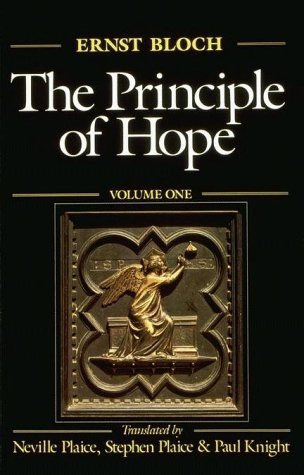
The Principle of Hope (German: Das Prinzip Hoffnung) is a book by the Marxist philosopher Ernst Bloch, published in three volumes in 1954, 1955, and 1959, in which the author explores utopianism, studying the utopian impulses present in art, literature, religion and other forms of cultural expression, and envisages a future state of absolute perfection. The Principle of Hope has become fundamental to dialogue between Christians and Marxists.
The Principle of Hope is one of the great works of the human spirit. It is a critical history of the utopian vision and a profound exploration of the possible reality of utopia. Even as the world has rejected the doctrine on which Bloch sought to base his utopia, his work still challenges us to think more insightfully about our own visions of a better world.
The Principle of Hope is published in three volumes:
Volume 1 lays the …
The Principle of Hope (German: Das Prinzip Hoffnung) is a book by the Marxist philosopher Ernst Bloch, published in three volumes in 1954, 1955, and 1959, in which the author explores utopianism, studying the utopian impulses present in art, literature, religion and other forms of cultural expression, and envisages a future state of absolute perfection. The Principle of Hope has become fundamental to dialogue between Christians and Marxists.
The Principle of Hope is one of the great works of the human spirit. It is a critical history of the utopian vision and a profound exploration of the possible reality of utopia. Even as the world has rejected the doctrine on which Bloch sought to base his utopia, his work still challenges us to think more insightfully about our own visions of a better world.
The Principle of Hope is published in three volumes:
Volume 1 lays the foundations of the philosophy of process and introduces the idea of the Not-Yet-Conscious - the anticipatory element that Bloch sees as central to human thought. It also contains a remarkable account of the aesthetic interpretations of utopian "wishful images" in fairy tales, popular fiction, travel, theater, dance, and the cinema.
Volume 2 presents "the outlines of a better world." It examines the utopian systems that progressive thinkers have developed in the fields of medicine, painting, opera, poetry, and ultimately, philosophy. It is nothing less than an encyclopedic account of utopian thought from the Greeks to the present.
Volume 3 offers a prescription for ways in which humans can reach their proper "homeland," where social justice is coupled with an openness to change and to the future.