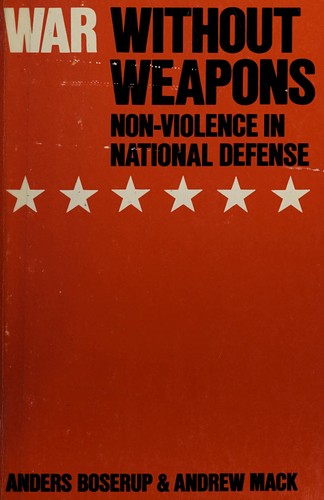
Is defense possible without weapons? Or does every state have to participate in the increasingly burdensome arms race for better and for worse? As the first country in the Western world, the NATO member country Denmark has commissioned a peace research institute to find answers to these questions, specifically: possibilities of defense without military armament through forms of nonviolent resistance (social defense) should be examined. The present volume is the result of this investigation, which is the subject of much discussion in Denmark. The authors soberly assess the methods of nonviolent resistance, the chances of which they do not overestimate. They show in detail the special military-strategic situation of smaller European countries, such as Switzerland, Sweden and Denmark. Using four examples, they demonstrate the socio-psychological prerequisites that would be necessary to ensure non-violent defense by citizens.
Using historical examples , proof is provided that the discussion of nonviolent resistance …
Is defense possible without weapons? Or does every state have to participate in the increasingly burdensome arms race for better and for worse? As the first country in the Western world, the NATO member country Denmark has commissioned a peace research institute to find answers to these questions, specifically: possibilities of defense without military armament through forms of nonviolent resistance (social defense) should be examined. The present volume is the result of this investigation, which is the subject of much discussion in Denmark. The authors soberly assess the methods of nonviolent resistance, the chances of which they do not overestimate. They show in detail the special military-strategic situation of smaller European countries, such as Switzerland, Sweden and Denmark. Using four examples, they demonstrate the socio-psychological prerequisites that would be necessary to ensure non-violent defense by citizens.
Using historical examples , proof is provided that the discussion of nonviolent resistance cannot be about morally rigorous concepts, but that the more realistically it is approached, the more successful it will be. The authors demand that socio-psychological and socio-economic factors be increasingly included in defense considerations and that the simple equation defiance force = military armament is finally exposed as a myth that is life-threatening for millions of people. From the nonviolent resistance of the Czechs to the Warsaw Pact troops, the authors draw the following conclusion: "Just as the Vietnam War proved that the military, at least in its traditional form, cannot claim a preferential position in an entire defense strategy, so the Czech resistance to the occupation ... became a demonstration of the possible benefits of nonviolent methods. As for the final result, in many respects the Czech resistance was a total failure. Therefore, one should not close one's eyes to the significant tactical victories of the first weeks
Small European nations might be better without a military?
2 stars
I did not really like this book. It was certainly a product of its time, including assuming the reader was familar with recent events like the non-violent resistance the Czecholsovokians utilized against the invading Soviet army. The athour frequently referenced "the literature" while he did include a reference in the books, but it was so academic to almost be pointless for the real world.
I did not really like this book. It was certainly a product of its time, including assuming the reader was familar with recent events like the non-violent resistance the Czecholsovokians utilized against the invading Soviet army. The athour frequently referenced "the literature" while he did include a reference in the books, but it was so academic to almost be pointless for the real world.