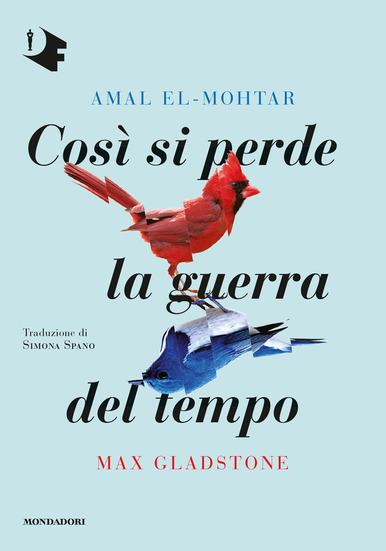

Così si perde la guerra del tempo

Paperback, 216 pages

Italiano language

Published Oct. 27, 2020 by Mondadori.

ISBN:
978-88-04-72982-2
Copied ISBN!

Tra le ceneri di un mondo in rovina, un'agente del comandamento trova una lettera: "bruciare prima di leggere". Inizia così la strana corrispondenza tra due agenti rivali, Rossa e Blu, emissarie di due fazioni in lotta, ciascuna desiderosa di controllare il passato per dominare il futuro. Ma quella che è iniziata come una sfida a distanza presto si trasforma in qualcosa di diverso. Qualcosa di epico. Qualcosa di romantico... Qualcosa che potrebbe farle uccidere. Perché in fine dei conti c'è una guerra in corso. E qualcuno deve vincerla. Non è così che funziona?

7 editions

Too much, but also not enough.

This was enjoyable overall. A love story unfolds amongst two rivals who are trying to destroy and revive the world respectively. It starts with little taunts left in unusual letters and blossoms into more as the story progresses. I found myself genuinely entranced with the characters and caring about their outcomes. The ending was not exactly expected so it took me by surprise a little.

The main reason I can't rate it higher is because of the world-building. There was both too much and not enough world-building going on. Too often I found myself confused and unable to track what was going on in the background. Once the story ramped up, it didn't matter as much because the information wasn't being handed out as much unless it directly affected the characters. I feel like if the world had been hashed out a little more, or even a little less, …

When two adversaries fall in love, winning or losing the time war may no longer be important

An interesting story of a two characters on opposite sides of a war fought through time. It begins with Red finding a letter with the words, "Burn before reading," which turns out to be from her adversary, Blue, who teases and challenges her before their next encounter. This time war is fought between two forces, Agency and Garden, who move agents (like Red and Blue) through time to tease and alter events so that, far in the future, victory is theirs.

Each chapter features an event as seen by Red or Blue, in alternate, with a hidden letter discovered by one or the other once victory (or defeat) is tasted by one or the other. But after a few rounds, the tone of the story changes, as both Red and Blue start to talk about their past, and their lives during the war. Then, events happen that show that …

Review of 'This Is How You Lose the Time War' on 'Goodreads'

Very enjoyable, quite romantic (even if I'm not that big of a fan of the enemies to lovers trope) and tells us a very important lesson: you win the time war by not writing about paradoxes, meeting your grandparents or much of the details of time travel in general.

Cute romance with a disappointing sci-fi setting.

Amal El-Mothar and Max Gladsonte's "This is How You Lose the Time War" follows two agents, Red and Blue, on opposite sides of a war that spans all of time and (some of?) space across multiple universes.

Each chapter starts with a snapshot of what each agent is doing to advance their side's cause, whether that's taking part in major historical events or planting the seeds for 'coincidences' in the future, and ends with the discovery of a letter from their counterpart. What begins as acknowledgements of respect, nods across the battlefield, gradually grow into something more.

Fans of science fiction may be disappointed by the lack of focus on the time-traveling, universe-hopping backdrop to this story of star-crossing lovers. Details are sparse, and little is disclosed about the factions or why they are at war other than hints and impressions throughout the book.

The gradual, tip-toeing …

A perfect book?

Quirky and unexpected, the things I appreciate most in a book. Also, not that long, which means it can't get too lost in it's unique abstractions. Loved it, will read it again.

Bigolas Dickolas was right

Beautiful novella! A lot of it is very abstract, on purpose. Like, how unlikely is it that two agents from rivaling parties both name themselves after colours, Blue and Red? It doesn't matter. Neither do the specific missions. The war events. The time strands.

What does matter, are the letters they send each other. The Seeker following them everywhere, snorting teapots like cocaine. And how they lose and win the time war.

Bonus points for the writing method (the two authors wrote the letters to each other, one after another, and built the universe that way). Bonus points for wlw romance. Bonus points for singing Steven Universe songs while writing the book. Bonus points for posing with swords on the backcover photo.

A piece of art

If you like books where you don't get all the answers, that aren't necessarily linear, and are more about prose and gut-wrenching heartache, you'll enjoy this book. It's art. If you don't like artsy books, you probably should pick something else to read.

I loved it.

Review of 'This is How You Lose the Time War' on 'Goodreads'

»This is How You Lose the Time War« is a truly stunning piece of writing.
I still can’t comprehend how Amal El-Mohtar & Max Gladstone could squeeze so many genres and ideas into such a short book, without it feeling overwhelming. Science fiction, space opera, star-crossed romance, time travel et cetera. It’s probably easier to count what this book is not than what it is.
Though I must admit that I found it a bit cheesy at the end, the book still managed to catch me off guard with heartbreaking plot twists. I don’t think I can ever reread this book without tears when Blue writes »As you wish« or the last sentences: »Maybe this is how we win, Red. You and me. This is how we win.«
Unconditional and unreserved reading recommendation!

Either too short, or too long.

No rating

I can't decide if this would have worked better (for me) as a short story, or a full length book. If it was longer, it could have expanded on it's ideas. If it had been shorter, it wouldn't have felt so repetetive.

There is some good ideas here, but they deserve better than being hand waved away. How do Red and Blue target their letters to each other across strands of time? If there are certain contested junctures in time, shouldn't they be swarmed with agents, and multiple aspects of the same agents? If the protagonists are just cogs in two massive opposing machines battling for supremacy over all time - why does it seems like they are the only two operators in the field?

I'm not saying this is a bad book, there is a lot good writing here. But it didn't work for me. Two highly …

a teapot in a tempest

"This is How You Lose the Time War" asks the reader to perch on the shoulders of two operatives on opposing sides of a time-traveling war.

Each chapter follows "Red" or "Blue" as they scurry up and down timelines and across dimensions. The book is both sweepingly broad and extremely contained and personal.

The settings flit by, dizzying: a temple for mechanized humans, an ancient holy cave, the assassination of Caesar - each sketched with broad, emotional strokes to give the setting an aesthetic. One gets the sense that a great web of cause and effect is being constantly constructed, altered, and destroyed, without ever seeing the full picture.

Against these backdrops, the characters "Red" and "Blue" write to each other - as nemeses, then as friends, ever deeper entangled even as they demolish each other's plans and forces. The letters make up an enormous part of …

Weird and beautiful but not always up to its own ambition

The letters that make up about half of this book are gorgeously written, and I love the story they tell. The basic idea of the time war is clever, and the descriptions of placetimes the characters find themselves in evocative, sometimes reminiscent of Calvino's Invisible Cities. I devoured this book in a few days.

And yet... something about it felt a little thin or hollow behind its fireworks. I think it was a good artistic choice to leave all technical details out, but I couldn't help but get hung up on the time paradoxes. Not that it's the authors' responsibility to necessarily avoid or solve them, but for me personally they intruded on the suspension of disbelief.

avatar for nylki

rated it

avatar for Slyphic

rated it

Subjects

  • science fiction
  • time-traveling
  • epistolary
  • LGBT
  • English literature
  • Fiction, science fiction, general

Lists