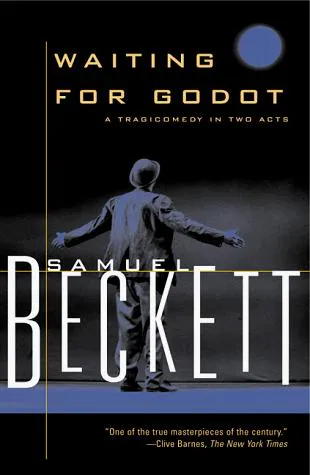

Julia_98 reviewed Waiting for Godot by Samuel Beckett
Standing Beside an Empty Road and Feeling Time Breathe
4 stars
Silence reached me before meaning did when I began reading Waiting for Godot. I entered the play expecting movement and resolution, but Samuel Beckett offered something far more unsettling. Two men, Vladimir and Estragon, stand beside a tree and wait for someone named Godot, who never arrives. At first, I felt almost impatient. I kept expecting a decisive event, a revelation, or at least a clear destination. Instead, I found myself entering a space where waiting itself becomes the central experience.
The play stands as one of the defining works of Existential Literature because it confronts uncertainty without trying to disguise it. As I followed the repeated conversations and circular exchanges, I began to feel that the absence of progress was not a flaw but the point itself. Vladimir and Estragon speak about leaving, remembering, suffering, and hoping, yet they remain where they are. I felt both amusement and …
Silence reached me before meaning did when I began reading Waiting for Godot. I entered the play expecting movement and resolution, but Samuel Beckett offered something far more unsettling. Two men, Vladimir and Estragon, stand beside a tree and wait for someone named Godot, who never arrives. At first, I felt almost impatient. I kept expecting a decisive event, a revelation, or at least a clear destination. Instead, I found myself entering a space where waiting itself becomes the central experience.
The play stands as one of the defining works of Existential Literature because it confronts uncertainty without trying to disguise it. As I followed the repeated conversations and circular exchanges, I began to feel that the absence of progress was not a flaw but the point itself. Vladimir and Estragon speak about leaving, remembering, suffering, and hoping, yet they remain where they are. I felt both amusement and discomfort during their interactions. Their dialogue often made me smile because of its absurdity, but behind that humor I sensed loneliness and quiet despair.
The arrival of Pozzo and Lucky disturbed me in a different way. Their strange relationship introduced questions of power, dependence, and human dignity. I felt confusion while reading their scenes, followed by a growing realization that confusion itself was part of the emotional landscape Beckett wanted to create. Nothing settles into certainty.
What affected me most was the play's treatment of hope. Waiting becomes a form of survival. Godot remains unseen, almost abstract, yet his possible arrival keeps the characters moving through another day. Reading this, I felt an unexpected sadness. I thought about how often people continue through routines, expectations, and promises that may never fully materialize.
Closing the play, I felt strangely quiet rather than frustrated. Waiting for Godot did not give me answers, and I eventually stopped asking for them. Beckett left me with something more difficult and more lasting: the awareness that meaning is not always found at the end of waiting. Sometimes it is hidden within the act of waiting itself.