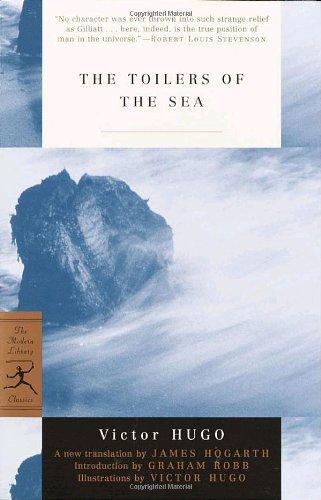

Julia_98 reviewed The Toilers of the Sea by Victor Hugo
The Heroism No One Truly Sees
4 stars
Victor Hugo’s The Toilers of the Sea drew me into a world where human endurance is tested against nature, isolation, and social prejudice. Set on Guernsey, the novel follows Gilliatt, a solitary man viewed with suspicion by his neighbors. He loves Déruchette, the niece of the shipowner Lethierry, but remains too distant and awkward to express his feelings openly.
The central conflict begins when Lethierry’s steamship is deliberately wrecked. Its valuable engine becomes trapped among dangerous rocks, and Lethierry promises Déruchette’s hand to whoever can recover it. Gilliatt accepts the challenge. His struggle at sea forms the novel’s most powerful section. Alone among cliffs, tides, storms, hunger, and exhaustion, he must use patience, intelligence, and physical strength to complete an almost impossible task.
I found these scenes both gripping and strangely meditative. Hugo describes the sea as beautiful, indifferent, and terrifying. It is not merely a setting …
Victor Hugo’s The Toilers of the Sea drew me into a world where human endurance is tested against nature, isolation, and social prejudice. Set on Guernsey, the novel follows Gilliatt, a solitary man viewed with suspicion by his neighbors. He loves Déruchette, the niece of the shipowner Lethierry, but remains too distant and awkward to express his feelings openly.
The central conflict begins when Lethierry’s steamship is deliberately wrecked. Its valuable engine becomes trapped among dangerous rocks, and Lethierry promises Déruchette’s hand to whoever can recover it. Gilliatt accepts the challenge. His struggle at sea forms the novel’s most powerful section. Alone among cliffs, tides, storms, hunger, and exhaustion, he must use patience, intelligence, and physical strength to complete an almost impossible task.
I found these scenes both gripping and strangely meditative. Hugo describes the sea as beautiful, indifferent, and terrifying. It is not merely a setting but an active force that exposes the limits of human control. Gilliatt’s battle with the giant octopus intensifies this feeling, yet the quieter dangers of weather and isolation seemed equally threatening to me.
The novel also explores sacrifice and unreturned love. Gilliatt succeeds, but success does not give him the future he imagined. Déruchette loves another man, and Gilliatt chooses to help them rather than claim the promised reward. His decision moved me because it transforms him from an isolated outsider into a figure of profound generosity. At the same time, his self-denial carries a painful sense of fatalism.
Although some descriptive passages felt demanding, I admired Hugo’s ambition. He combines adventure, symbolism, romance, and philosophical reflection. The novel asks whether courage has value when society fails to recognize it, and whether love is still meaningful when it cannot be possessed.
I finished The Toilers of the Sea feeling both admiration and sadness. Gilliatt’s strength conquers machinery and nature, but not loneliness. For me, that contrast gives the novel its lasting emotional power. His victory therefore feels noble, incomplete, and almost unbearably human.