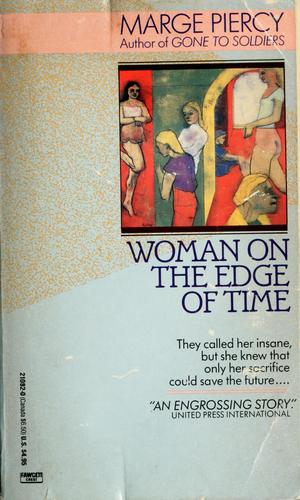
I'll start off this review by saying that I'm probably being harsher on this book than I should be due to my general distaste for second-wave feminism and 60s and 70s era environmentalism, which are the two main traditions this book seems to come from. Perhaps in a book aligned more with my politics, I would have forgiven more of my frustrations with the characters, dialog, and worldbuilding. But as it was, I disliked this book.
The narrator/protagonist is a Connie, a Mexican-American woman (written by a white author), and the book opens up with her living in a slum, talking about the drugs and crime there, and interacting with her niece, who is a sex worker, something the protagonist clearly feels disgust about — disgust that feels like it comes straight from the author, since there doesn't seem to be much of any attempt to subvert that or make any real point about it.
Connie is wrongfully and maliciously checked into a mental institution in the first chapter. The book's criticism of institutionalization and dehumanization of people with mental illnesses is where it's at its best, I think, although that point is perhaps undercut by focusing on a character who does not seem to have any real mental health problems, or at least if she does, they're not the ones she's checked in for.
Connie is contacted by Luciente, a person from the future, who assists her in astrally projecting (it's not called that, but that is the kind of thing it is) into the future, so that they can show her their utopian society, where all the goals of feminists and environmentalists in the 70s have been enacted.
In order for the book to be able to explain everything to the reader extremely directly and with no subtlety at all, Connie is written as a complete bumbling idiot who can't understand anything in the future being different from the way it was in the past. There are probably at least a hundred instances of dialog where someone from the future says something that like. Might be a little but surprising but really isn't hard to wrap one's head around, and Connie just expresses complete shock and disbelief, prompting them to explain in more detail — I was nearly shouting "show, don't tell!" to myself by the end of the book.
The actual world seems either not well thought through, not well explained, or maybe both. There is a mix of return-to-the-land style agrarian aesthetics and high-tech gene-editing, voice-recognizing smartwatches, holographic projectors, etc that would nowadays probably be recognized as solarpunk, but without any real analysis of how these technologies exist in a society structured as they are. I'm not sure exactly how much I can blame the author for this — I have both a deeper understanding of technology and nearly 50 years more history of the technology industry to draw on, but it seems like it should have been pretty obvious by the late 70s that you don't end up with high-tech devices without a society that is geared around technology — this book seems to exhibit a sort of magical thinking around technology that you can simply pick and choose the good bits of technology without worrying at all about the systems that create that technology. Unfortunately, this is disastrously wrongheaded and this very ideology remains a looming and destructive force today.
Another place where the book seems to not really be thinking carefully is around race. One of the first things that we learn about the future society is that all babies are grown in-vitro — this, I believe, comes from extremely second-wave-feminist ideas about reproduction being the fundamental difference between men and women — thus, eliminating that difference is a prerequisite for equality between the sexes. In the same chapter that this is explained, one of the characters casually mentions that "decisions were made forty years back to breed a high proportion of darker-skinned people and to mix the genes well through the population" — this is the first of two instance that the book just casually mentions eugenics without calling it as such, assuming that you'll be on board with it because it seems progressive and nice, but it immediately raises a lot of questions for me. How did racial minorities feel about the idea of destroying the concept of race, for instance? What did the breakdown of how people voted on that look like by race?
In this same conversation — the same quote, even — a character mentions that they still have "separate cultural identities", and that "Wamponaug Indians are the source of our culture" in the particular community that Luciente is from. As far as I can tell, this does not have any actual meaning — I read a fair amount about the Wampanoag after reading this book to try to figure out if this referred to any actual concrete thing, and I couldn't find anything in the book that seems to actually be related to any real Wampanoag traditions.
This idea that different communities retain their separate cultures also seems to kind of fundamentally misunderstand what a culture is, seeming to see it as a purely aesthetic thing that can just be draped over any society without really changing anything fundamental.
I was very excited to see this explored more when Connie briefly ran into a Ashkenazi character — immediately that brought up some extremely interesting questions — does Judaism still exist? How does religion fit into society, given the huge changes in power structures? If Judaism no longer exists, what meaning does Ashkenazi culture have? I was hoping that some of these questions would be answered — and it would probably answer some of my other questions as well, since apparently the Ashkenazi community is the one that manufactures the smartwatch-computer things — but instead it's simply a strange aside that raises so many more questions than it answers.
The gender politics of this book seemed to come from a extremely cis perspective. There is complete equality between sexes, and gendered pronouns have been eradicated (using instead "per" and "person", a odd choice when "they" has been a non-gendered singular pronoun in English for centuries, but I guess that's always confused boomers). While elective procedures to modify appearance are explicitly mentioned in the book — they talk about using some kind of gene-editing technology to change hair colors — the idea that someone might want to change their sexual characteristics is completely absent, except that hormone therapy is specifically mentioned but for the sole purpose of allowing men to breastfeed babies. I guess it's fine — I am someone who wants to abolish gender, so what's described in this book is actually very close to something I want, just not quite — I take bodily autonomy as a fundamental value, but it seems like that's not so important for the author, given that giving birth "naturally" seems forbidden? Unsurprisingly, the author seems to be a TERF, which is unfortunate, since abolishing gender and making hormone therapy widely available is what a lot of trans people actually want, and seems quite in line with feminist goals.
The book goes a little bit into how decisions are made, but not to nearly the extent I'd like — since I think that's one of the most important things in evaluating a society. It seems like there's some combination of a relatively anarchistic way of making local decisions, with various levels of councils with members selected by lot among interested parties for larger decisions, but no real details are established. It sounds like this way of life is essentially worldwide — there is a unspecified enemy who has bases in Antarctic and on space platforms (how do they get any resources? this question is, of course, not answered), but other than that, everyone on Earth seems bought into this way of life. How many people is that, and how aligned are we? We're left to wonder, although apparently this worldwide consortium sets limits on the number of births and is in the process of reducing the population. I don't feel like I should need to point out that the necessity of reducing the population is a ecofascist talking point, but it's interesting to see the history of it.
I think this book actually does a really interesting job of summarizing my feelings about second-wave feminism, the environmentalism movement, and the hippies — a lot of the concrete things, they got right, but they didn't have the perspective or conceptual tools needed to really understand the systems they were operating in. As such, many of the concrete things in this book do indeed seem utopian, but nothing fits together quite right, and everything has to be held together with a combination of magical thinking, not looking too closely at the details, and ignoring the minor little bits of eugenics, coercion, and ecofascism that are apparently necessary for everything to run smoothly.